
Bad data doesn't just slow AI down; it turns your most confident tool into your most dangerous one. But getting your data in line isn’t the only hurdle to being ready to embrace AI. So, how do we advise Echelon customers on being “AI-ready”? It’s not just the core data platform (CMDB) - it’s the whole gamut: instance, team, and executive alignment.
In this article we step through the 3 pillars we guide customers through when preparing to deploy Echelon:
Instance readiness: is my data & documentation in line?
Team readiness: are my team able to adopt AI process & work approaches?
Executive readiness: are my exec team aligned on the investment needed to see results & what those results should look like?
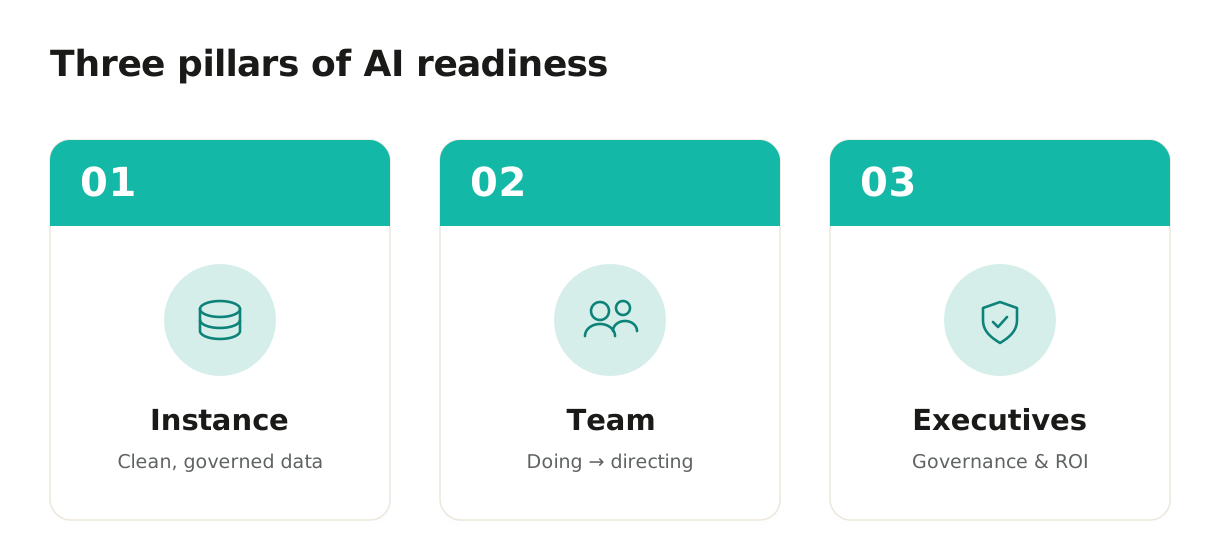
Getting AI-ready in ServiceNow means clearing three bars: your instance, your team, and your executives. Miss any one and the initiative stalls, and it starts with the data your instance runs on.
Why is the readiness process so critical?
“Imagine your Knowledge Base contains an article stating that orange juice comes from apples. A human agent would pause, realize the error from intuition alone, and go looking for a better source. AI won't. It reads that article, synthesizes it with total confidence, and tells every employee who asks that squeezing apples is how you make orange juice.” - Alvis Chan, Echelon’s AI Delivery Architect and ServiceNow CMA for over half a decade.
AI amplifies everything you already “know” - good or bad. That's the Orange Juice Test — the fastest way to understand why AI readiness evaluation has to start with data quality, not feature configuration, fancy demos, or new tools.
Data is only the first of three things that have to be ready. Getting AI-ready in ServiceNow means clearing three bars: your instance data, your team, and your executives.
Pillar 1: Instance Readiness
A clean instance is a prerequisite. Per ServiceNow's own guidance, a healthy CMDB is foundational for AI-driven automation and Now Assist accuracy.
Audit Knowledge Base accuracy. Purge outdated articles — every stale one is hallucination fuel.
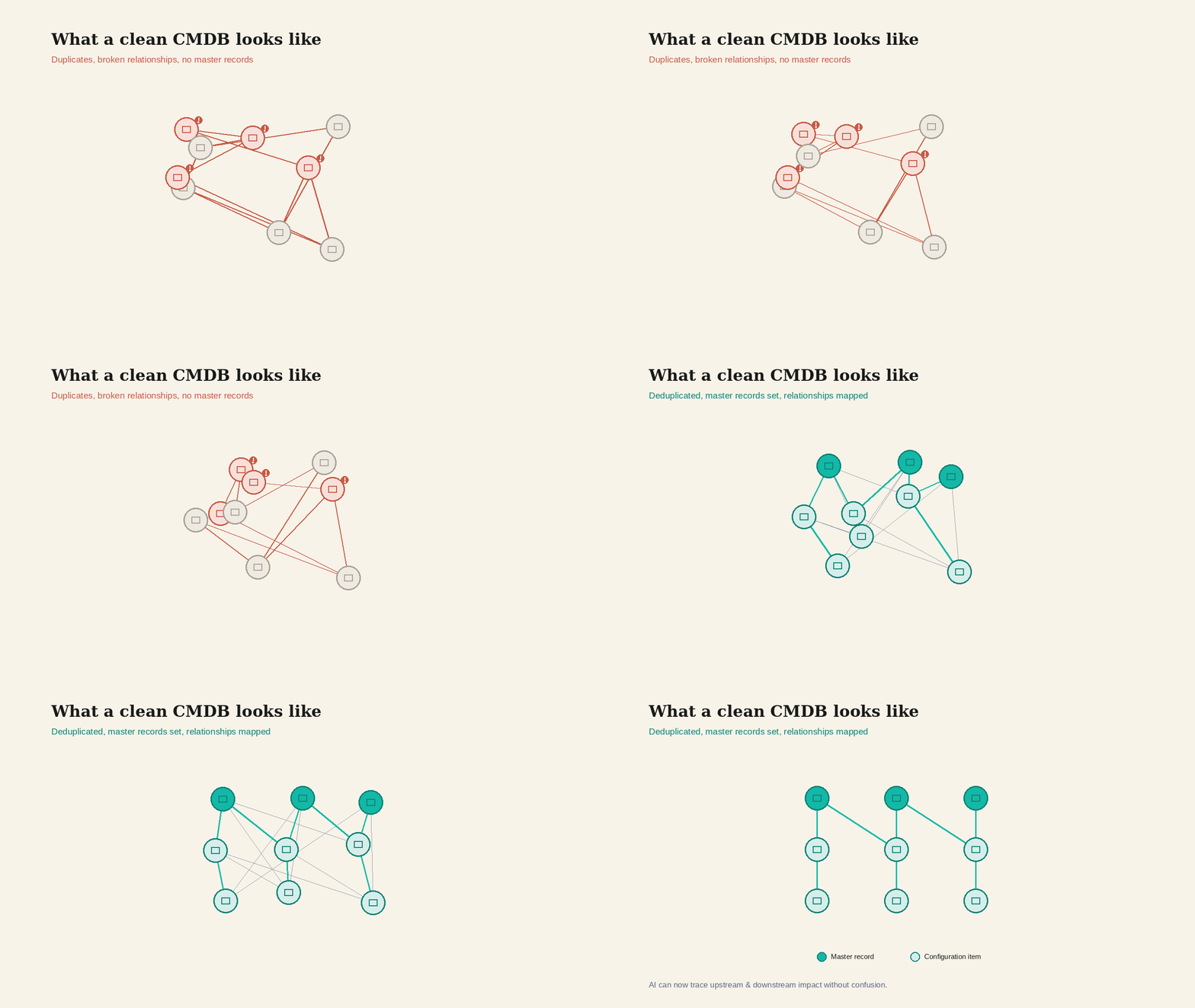
Fix CMDB hygiene. Resolve duplicate configuration items, establish master records, and fix relationships based on CSDM. This allows AI automations to trace upstream & downstream impacts without confusion.
Enforce closure discipline. Enforce correct categorization/configuration item at closure - pattern detection can only learn from the truth, not from “Miscellaneous”.
Standardize workflows. Map and document processes across case types. AI acts reliably only when the steps it learns are repeatable.
Modernize the UI. Transition from Legacy UI (UI16 + Agent Workspace) to Next Experience + Configurable Workspace. This is required to unlock NowAssist features.
How do you test AI readiness?
AI doesn't fix bad data; it amplifies it. Delivering wrong answers faster, to more people, with more authority than any human agent could. As Alvis Chan, AI Delivery Architect at Echelon AI, puts it: “The simplest test: If a human can find the right answer in that database, then we're ready to use AI.” The inverse is just as true: if your team can't surface accurate answers manually, AI has no foundation to stand on.
How can Echelon accelerate instance data readiness?
Echelon’s AI agents shorten CMDB assessments from weeks, often with a consultant or 3rd party grow costing 6-figures, down to a single hour. Echelon connects to your instance via a read-only connection, scans for broken relationships & dangling CIs, and compiles this to a report for your team to read through.
Scan done, Echelon then systematically fixes each broken relationship exactly to your CSDM standards: importantly, Echelon then continuously monitors for new breaks so your CMDB remains aligned.
Understand more about how Echelon can keep your CMDB healthy here, or schedule your one hour CMDB assessment.
Pillar 2: Team Readiness
The technology is the easy part; the people are where readiness stalls. It starts with roles, habits, and documentation.
Redefine senior roles from “doing” to “directing.” Reviewing, correcting, and coaching AI outputs is the biggest cultural shift your architects, engineers, and analysts will face. They’re no longer doing every step of the work - they’re guiding AI to do it. This takes time to learn, practice, & embrace across more and more of their work.
Kill tribal knowledge. Make work notes a non-negotiable, auditable standard — if a process lives only in someone's head, the AI can't learn it.
Train teams on prompting. Adopt the Now Assist AI Agents Prompting Guide. Low cost, measurable impact.
Pillar 3: Executive Governance
According to Fast Company, “60% [of execs when talking about AI investments] report minimal returns despite real investment.” - yet teams that get it right see massive returns. Why?
Without executive alignment on targets, investment, & governance, even a sound experimental process to understand if AI works for your team will drift — chasing demos instead of outcomes. The common failure isn't bad technology; it's leadership mistaking a prototype for a strategy.
Define ROI metrics before deployment. Anchor to two: MTTR reduction (complex issues resolved faster) and deflection rate (routine requests handled end-to-end). Track both.
Fund data debt clearance as a line item. Licensing AI while leaving stale data in place is a contradiction — and legacy customizations that bypass standard APIs break AI entirely.
Align capabilities to real demand. Prioritize use cases backed by volume data and user pain — not vendor-demo excitement.
* MTTR: mean-time-to-repair - how much faster can complex tickets be handled & issues repaired.
* Deflection rate: the number of tickets AI can handle end-to-end without a human intervening.
The Bottom Line: Four Things to Validate
Data first. Audit, deduplicate, and close coverage gaps before AI touches a single ticket.
Standardize the environment. Migrate to Polaris UI and clear technical debt — skipping this surfaces only after go-live, when it's costly to fix.
Train your people. Structured work notes plus basic prompting skills give AI something it can use.
Govern with the right metrics. Track resolution quality, deflection, and hallucination frequency — not just ticket velocity.
The hard part isn't knowing these steps; it's executing them fast enough to match business demand. Manual technical debt doesn't clear itself.
That's where automation changes the equation. EchelonAI automates the end-to-end ServiceNow lifecycle, from requirement gathering through governance review to production deployment — compressing months into weeks. One documented migration took a 200-item catalog project from six months to six weeks.
Whatever your priority, Now Assist for ITSM, employee support, or agentic workflows — the requirement is the same: a clean, governed, well-structured instance. Getting there manually is possible. Getting there in time to matter isn't.
Footnotes:
CMDB (Configuration Management Database): a central repository that stores information about an organization's IT assets (configuration items) and the relationships between them.
CSDM (Common Service Data Model): ServiceNow's standardized framework and best-practice blueprint for structuring and organizing CMDB data across products.